

Every relocation guide agrees on one thing: Spain is cheaper than most of Western Europe and North America. Almost none of them agree on what that actually means in euros. Search around, and you'll find single-person budgets ranging from €1,000 to €2,500 a month, "moving cost" estimates anywhere from €2,000 to €20,000, and visa fee numbers that seem to contradict each other depending on which site you land on.
The truth is that most of those numbers aren't wrong — they're just answering different questions. "Cost of living" and "cost of moving" are two separate budgets, and conflating them is exactly why people underestimate how much cash they need in the first three months versus how much they'll settle into spending every month after that.
This guide splits the two apart deliberately: first the one-time relocation costs you'll pay before you're settled, then the realistic ongoing monthly budget once you are. Every figure here reflects 2026 pricing. If you'd rather skip the spreadsheet entirely and have someone build your actual numbers with you, that's what a Free 15-Minute Consultation is for — but the framework below will get you most of the way there on your own.
Part 1: The One-Time Cost of Moving (Before You're Settled)
This is the money you spend once to get from "deciding to move" to "actually living in Spain." It's the number most people underestimate, because it's scattered across a dozen small line items rather than one obvious bill.
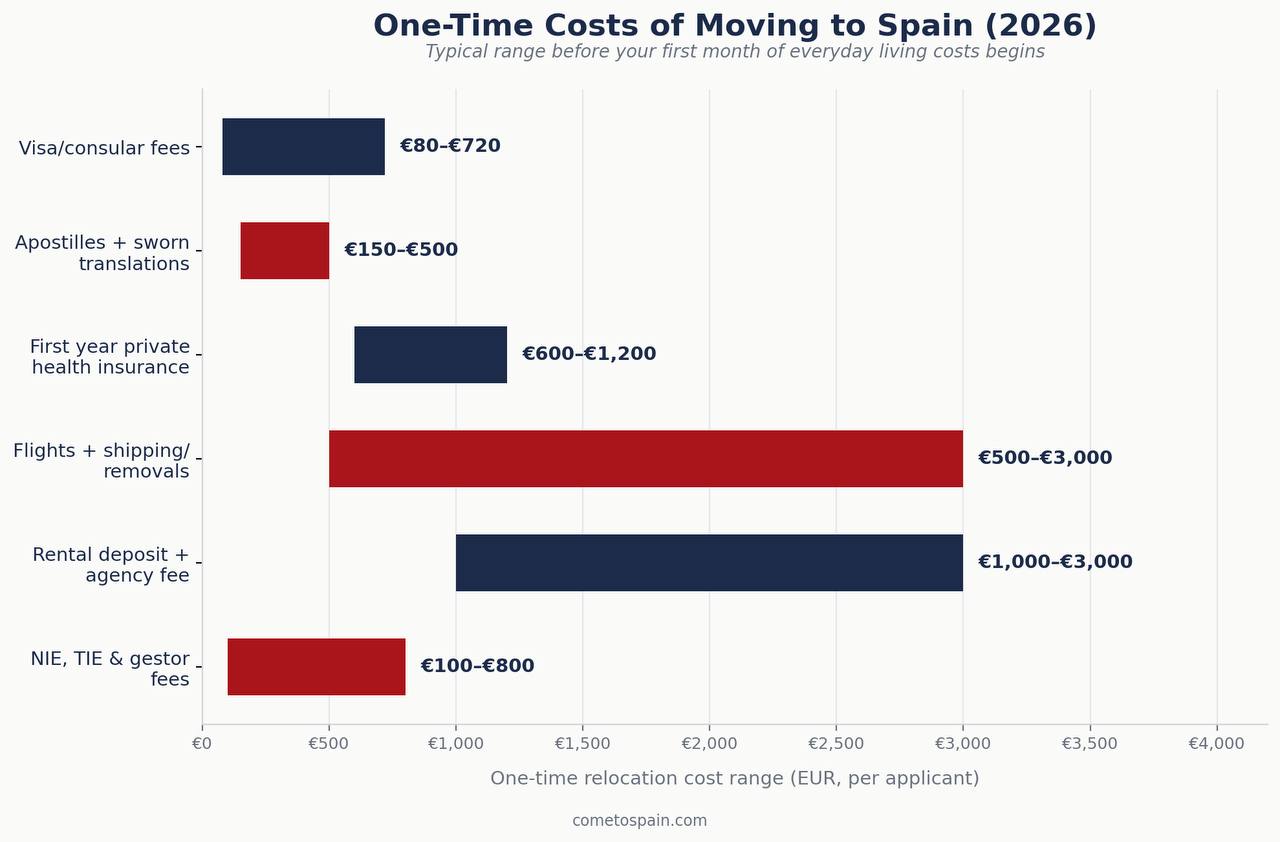
Visa and Consular Fees: €80–€720
This is the single most misquoted number in every relocation article, because the answer genuinely depends on your nationality. Most nationalities pay Spain's standard consular fee, which sits around €80. But Spain applies reciprocity pricing on visa fees — meaning if your home country charges Spanish nationals more for an equivalent visa, Spain charges you the same rate back. UK applicants, for example, currently pay in the range of £345–£719 (roughly €400–€840) per person because of reciprocity pricing tied to UK visa fees for Spanish nationals. Always check the fee specific to your nationality at your assigned consulate rather than assuming the "standard" €80 figure applies to you.
Document Preparation — Apostilles & Sworn Translations: €150–€500
Every foreign public document you submit (criminal record checks, marriage or birth certificates, sometimes degree certificates) needs an apostille — international certification recognized under the Hague Convention — before Spain will accept it. Apostille costs are set by your home country, not by Spain: in the UK it's roughly £30 per document through the standard FCDO service; in the US it's typically $20–$50 per document at the state level, though expedited or hand-carry services can push individual documents to $150–$300 when you're working against a deadline.
On top of the apostille, any document not already in Spanish needs a certified/sworn translation (traducción jurada) — budget roughly €30–€80 per page, depending on the translator and document complexity.
First Year of Private Health Insurance: €600–€1,200
Most visa types (Digital Nomad, Non-Lucrative, Student) require proof of private health insurance with no co-payments (sin copago) from an insurer authorized to operate in Spain — a standard international travel policy generally won't satisfy this. Many consulates and the UGE-CE want to see this paid or committed for upfront, which is why it lands in the one-time bucket rather than the monthly one, even though you'll obviously keep paying it monthly afterward. Insurers commonly accepted for visa purposes include Sanitas, Adeslas, Asisa, Cigna España, and DKV — premiums vary mainly based on the hospital network covered and your age. If you'd rather not compare six providers' small print yourself, our Private Health Insurance service exists specifically to match you with a visa-compliant policy the first time, rather than risking a rejected application over a policy that looked fine but technically wasn't.
Flights, Shipping & Removals: €500–€3,000+
The widest range on this whole list, because it depends entirely on how much of your life you're bringing. A single flight and two suitcases sit at the low end; a container shipment of furniture and a full household move sit at the high end, sometimes well above it. If you're moving with pets, add a separate and often-overlooked line item for pet transport and import paperwork.
Rental Deposit & Agency Fee: €1,000–€3,000
Spanish landlords typically ask for one to two months' rent as a deposit, sometimes with an additional month if you're using a letting agency, plus the agency's own fee (commonly equivalent to one month's rent). On a €1,000/month apartment, that alone can mean €2,000–€3,000 in cash needed before you get keys — a number that catches people off guard even when they've budgeted carefully for the move itself.
NIE, TIE & Gestor Fees: €100–€800
Your NIE (foreigner tax ID number) itself has a genuinely tiny official government fee — currently €9.84 (Tasa 790-012) if you handle it yourself in person in Spain. What actually drives the cost up is everything around it: power-of-attorney drafting if you're applying remotely, courier costs, and — if you use a gestor or legal representative to handle the appointment and paperwork for you — professional fees typically in the €200–€500 range. Our NIE Application service covers exactly this: we handle the paperwork so a €9.84 government fee doesn't turn into a wasted morning and a missed appointment slot.
Realistic One-Time Total
Adding it up, a single applicant handling everything independently should budget somewhere in the €2,500–€6,000 range for the full one-time relocation cost, before their first month of everyday living begins — with the spread driven almost entirely by shipping choices, nationality-based visa fees, and whether you use professional help at each step. Families multiply several of these line items per person, which is easy to forget when eyeballing a single-applicant number and assuming it scales linearly (it doesn't — it scales faster).
The Line Items People Forget Entirely
Beyond the six categories above, a handful of smaller costs rarely make it into a first-pass budget but reliably show up in real relocations:
Medical certificate. Several visa categories require a signed medical certificate confirming you don't carry any disease with serious public health implications. Typically €50–€150 depending on your doctor and whether it needs to be apostilled and translated as well.
- Criminal record certificate re-issuance. Because these documents are only valid for a limited window (commonly 90 days from issuance for consulate submissions), a slow-moving application can force you to redo this step — certificate fee, apostille, and translation, a second time.
- Currency conversion and international transfer fees. Moving savings or a rental deposit across currencies through a traditional bank can quietly cost 2–4% in hidden exchange-rate margin. Using a mid-market-rate service (Wise is the most commonly cited example) instead of a standard bank transfer is a small effort that measurably protects a large one-time sum.
- Temporary accommodation. Most people don't sign a permanent lease sight-unseen from abroad — a few weeks in short-term/Airbnb-style accommodation while apartment-hunting in person is common, and at €40–€80/night, two or three weeks adds a genuine four-figure sum that a lot of first-pass budgets miss entirely.
- SIM card and initial mobile setup. Minor individually (€10–€30 for a starter SIM), but worth listing since you'll need it functioning before several other steps — including the bank account and rental applications that expect a local number.
None of these individually break a budget. Collectively, they're often the gap between the number someone planned for and the number they actually spent.
Part 2: Your Real Monthly Budget Once You're There
This is the number that matters for the long run, and it's where Spain's reputation for affordability genuinely holds up — once you get past the one-time costs above.
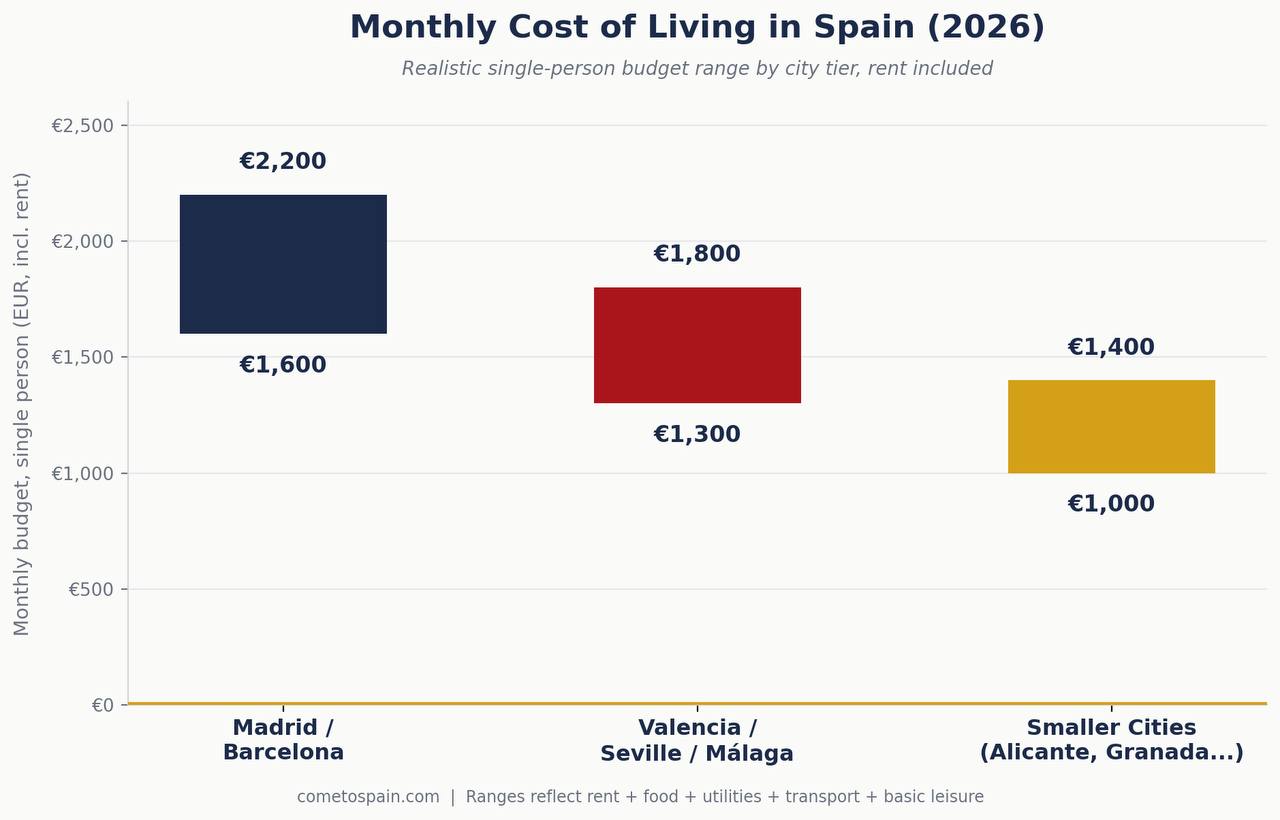
Madrid & Barcelona: €1,600–€2,200/month
Spain's two largest cities carry the country's highest rents by a meaningful margin — a one-bedroom apartment in a desirable central neighborhood (Salamanca in Madrid, Eixample in Barcelona) can run €1,200–€1,600 on its own, though outside the most sought-after districts €800–€1,200 is more typical. You're paying for the deepest expat community, the best international flight connectivity, and the widest range of coworking spaces in the country — real advantages, but ones with a real price tag attached.
Valencia, Seville & Málaga: €1,300–€1,800/month
This tier has become the default recommendation for a lot of remote workers and retirees specifically because it keeps almost everything that makes Madrid and Barcelona appealing — real infrastructure, international communities, functioning healthcare, direct flights — while cutting rent by roughly 30–40%. A one-bedroom outside the absolute center typically runs €500–€800, and Valencia alone now has over 150,000 foreign residents, so "international community" isn't a marketing phrase there — it's a demographic fact.
Smaller Cities (Alicante, Granada, smaller coastal towns): €1,000–€1,400/month
The trade-off flips here: meaningfully lower costs, often a more genuinely local day-to-day experience, but a smaller international community and, outside the city center, more reliance on a car than the larger cities require. Rent for a one-bedroom can fall as low as €350–€600 in some of these locations.
Where the Money Actually Goes
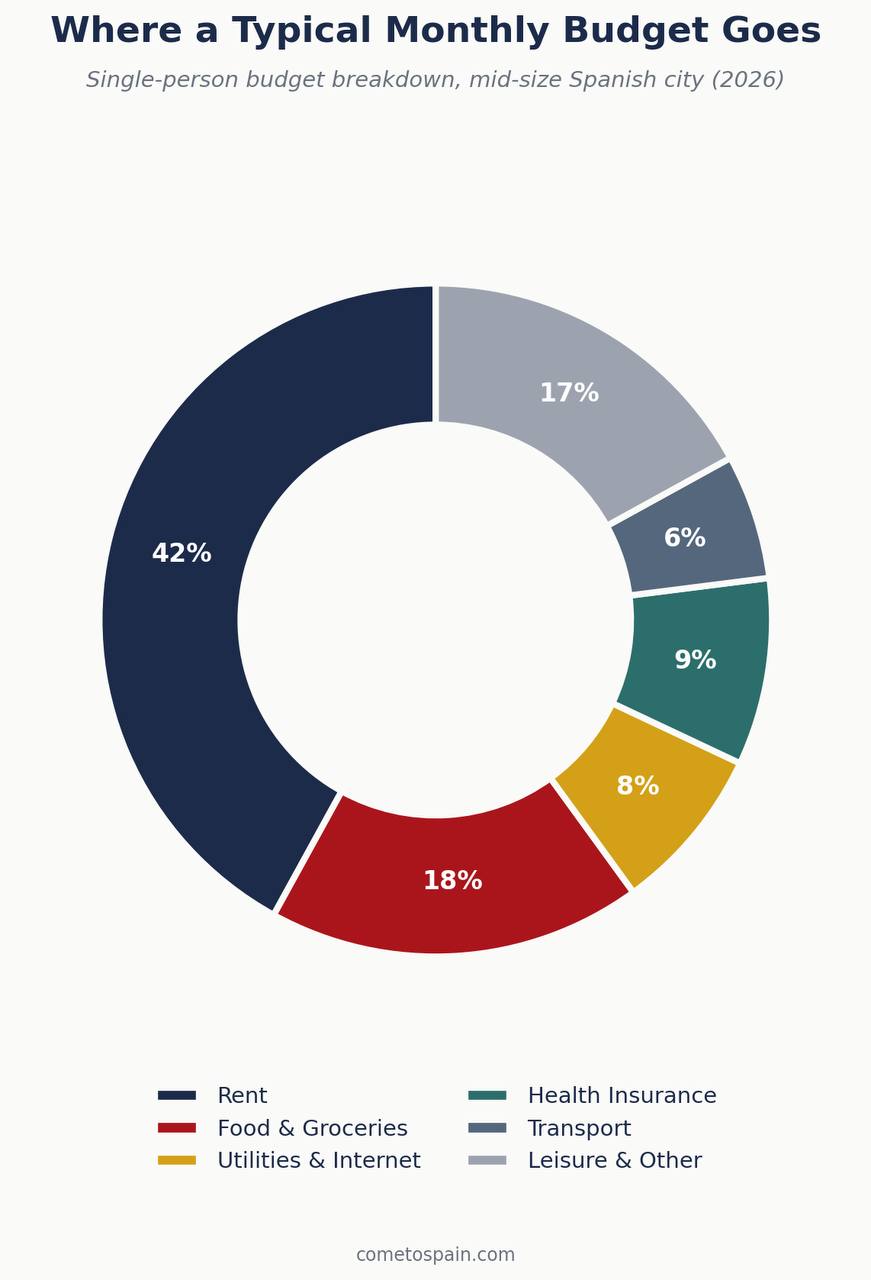
For a single person settled into a mid-size Spanish city, a fairly typical monthly split looks like:
| Category | Typical Monthly Cost | % of Budget |
| Rent | €600–€1,100 | ~42% |
| Food & groceries | €200–€300 | ~18% |
| Health insurance (private top-up) | €50–€100 | ~9% |
| Utilities & internet | €110–€160 (per household) | ~8% |
| Transport | €40–€55 | ~6% |
| Leisure, dining out & other | Variable | ~17% |
A few numbers worth calling out individually: the menú del día (a full two-or-three-course set lunch with a drink) typically runs €10–€15 and remains one of the genuinely great value propositions of daily life in Spain, even in expensive cities. Public transport is efficient enough in most cities that going car-free is a realistic option, particularly in Madrid, Barcelona, Valencia, and Seville — a real ongoing saving compared to countries where a car is close to mandatory.
Couples and Families
Couples should generally budget €2,200–€3,000/month; a family of four typically needs €2,600–€4,200, with the range depending heavily on schooling choices — private/international schooling for children can add a substantial line item that public schooling doesn't carry, and is worth researching specifically for your target city before you commit to a neighborhood.
A Closer Look at Rent by City
Because rent is consistently the single largest line item — 42% of a typical budget, as the chart above shows — it's worth breaking down further than the three broad tiers already covered:
| City | 1-Bed, City Center | 1-Bed, Outside Center | Notes |
| Madrid | €1,000–€1,500 | €700–€1,000 | Best flight connectivity in the country |
| Barcelona | €1,100–€1,600 | €750–€1,100 | Slightly pricier than Madrid on average |
| Valencia | €650–€950 | €500–€700 | Large international community, beach access |
| Seville | €600–€850 | €450–€650 | Warmer climate, strong local culture |
| Málaga | €700–€1,000 | €500–€750 | Fast-growing tech/startup scene |
| Alicante | €550–€800 | €400–€600 | Popular with northern European retirees |
| Granada | €500–€750 | €350–€550 | Historic center, lower overall costs |
A national average sits around €877/month for a city-center one-bedroom and €688 outside it, according to Numbeo's January 2026 figures — useful as a sanity check against whatever specific city numbers you're working from, though as the table shows, the spread around that average is wide enough that the average alone isn't a particularly useful planning number on its own.
Worth flagging directly: rents rose 3–8% in 2025, and most forecasts for 2026 point to a further 3–5% increase, concentrated most heavily in Madrid, Barcelona, and coastal hotspots under the most rental pressure. If your target city is one of these three categories, budgeting toward the higher end of whatever range you find — including the ranges in this guide — is the more realistic planning approach.
Education Costs, If You're Moving With Children
For families, schooling is often the single decision that swings the monthly budget more than any other choice. Spain's public school system is free and generally well-regarded, and is the default choice for most long-term resident families, particularly once children have some baseline Spanish. International and bilingual private schools — the more common choice for families planning a shorter stay or wanting continuity with a specific curriculum (British, American, IB) — typically run €400–€1,200/month per child, depending on the city and the school's reputation, with Madrid and Barcelona's most established international schools sitting at the top of that range. This single decision is often the difference between a family of four's monthly budget sitting at €2,600 versus closer to €4,200.
The Health Insurance Line Item Deserves Its Own Section
This one gets its own callout because it's simultaneously mandatory for most visa categories, genuinely confusing to shop for correctly, and one of the more common reasons applications get flagged.
The requirement isn't just "have health insurance" — it's specifically a policy with no co-payments from an insurer authorized in Spain. A perfectly good international travel insurance plan from your home country, even an expensive one, typically won't satisfy this because it's the wrong product category, not because of price. Premiums for compliant policies commonly start around €50/month for younger applicants and scale up with age and hospital network breadth — Sanitas and Adeslas tend to have the broadest networks, which matters if you already know which city or region you're settling in and want a policy that actually covers the hospitals near you.
Once you're a legal resident registered for employment or self-employment, you also gain access to Spain's public healthcare system (SNS), which is free or low-cost and consistently rated among the best in the world — many long-term residents keep a modest private policy as a top-up for shorter wait times rather than relying on it exclusively, once they're eligible for public coverage.
Ways People Actually Reduce Their Budget (Without Cutting Corners That Matter)
A few adjustments show up repeatedly in real relocation budgets that come in under the ranges above:
- Choosing a city 20–30 minutes outside the main tourist center of wherever you're settling can save €300–€500/month on rent alone, often without meaningfully changing your quality of life.
- Shopping local markets rather than supermarkets for fresh produce — commonly half the price, frequently better quality.
- Timing your move for autumn or winter rather than peak summer, when rental availability is better, and prices are less inflated by seasonal demand.
- Learning basic Spanish early — this doesn't just help socially; it measurably reduces "expat pricing" on services where a local rate and a foreigner rate quietly diverge, and makes dealing with tradespeople, landlords, and local bureaucracy considerably smoother. Our Language Learning support exists for exactly this reason — it's a financial decision as much as a cultural one.
- Going car-free where the city supports it (Madrid, Barcelona, Valencia, Seville) rather than assuming you'll need one — Spain's public transport in these cities is genuinely good enough to make this realistic for most daily routines.
None of these require sacrificing the things that made you want to move to Spain in the first place — they're mostly about not defaulting to the most expensive version of each decision without checking the alternative first.
A Sample First-Year Budget, Put Together
To make this concrete, here's what a single applicant on the Digital Nomad Visa, settling in Valencia, might realistically budget for their first twelve months:
One-time costs (Month 1):
- Visa/consular fees: €80
- Apostilles + sworn translations: €300
- First year health insurance (paid upfront): €800
- Flight + minimal shipping: €600
- Rental deposit + agency fee: €1,600
- NIE/TIE + gestor assistance: €350
One-time subtotal: ≈ €3,730
Monthly costs (Months 1–12, Valencia mid-range):
- Rent: €700
- Food & groceries: €250
- Utilities & internet: €130
- Transport: €45
- Leisure & other: €250
Monthly subtotal: ≈ €1,375 × 12 = €16,500
Realistic first-year total: ≈ €20,000–€21,000, or roughly €1,700/month averaged across the full year once the one-time costs are smoothed out. That figure sits comfortably below what the same standard of living would cost in most major North American or Northern European cities — which is, ultimately, the number most people moving to Spain actually want to know.
Common Budgeting Mistakes We See
- Forgetting the deposit-plus-agency-fee stacking. Two or three months of rent due at signing, in cash, before you've earned anything locally, catches people who budgeted only for "first month's rent."
- Assuming their home-country insurance qualifies. It usually doesn't, and discovering this during the visa application — rather than while comparison-shopping calmly beforehand — is a stressful and avoidable way to find out.
- Underestimating nationality-based visa fee differences. Budgeting €80 when your actual consular fee is closer to €700 is a five-times error that's entirely avoidable by checking your specific consulate's fee schedule early.
- Treating "cost of moving" and "cost of living" as the same number. They're not, and conflating them either leads to sticker shock in month one or an inflated sense of ongoing monthly cost that doesn't match reality after the dust settles.
Not budgeting a buffer for the first few weeks. Bank account setup, initial appointment costs, and the general friction of getting oriented in a new country all cost more than they will once you're established — a buffer of a few hundred euros for the first month specifically is worth building in deliberately.
Taxes: The Budget Line That Isn't Really Optional
No cost-of-moving guide is complete without at least flagging tax residency, because it changes your real disposable income more than almost any line item covered so far — and it's not a one-time or monthly bill so much as a structural fact about how your income gets treated.
Spend more than 183 days a year in Spain, and you generally become a Spanish tax resident, which means Spanish tax rules apply to your worldwide income, not just what you earn locally. Spain holds double taxation agreements with the US, Canada, the UK, Australia, New Zealand, and every EU member state, among others — so residents from these countries generally won't be taxed twice on the same income, but the mechanics of how that plays out depend on your specific income type and country of origin.
Many new residents — particularly Digital Nomad Visa holders — look into Spain's special expatriate tax regime (informally called the "Beckham Law"), which under qualifying conditions allows a flat rate on Spanish-sourced income rather than Spain's standard progressive rates, for a limited number of years after arrival. Whether this applies to your situation, and whether it's actually advantageous compared to your standard tax position, depends heavily on your income level and structure — this is genuinely a "talk to a specific tax advisor" situation rather than a general-guide one, but it's worth raising early, before your move, rather than during your first Spanish tax filing.
How Spain Compares to Other Relocation Destinations
Numbers in isolation are hard to judge — they're more useful next to something. Here's roughly how Spain's monthly cost of living stacks up against a few of the destinations people most often compare it with when deciding where to relocate:
| Destination | Single-Person Monthly Budget (approx., incl. rent) | How It Compares to Spain |
| Spain (mid-size city) | €1,300–€1,800 | Baseline |
| Portugal (Lisbon/Porto) | €1,400–€2,000 | Similar to, slightly higher, especially Lisbon |
| France (outside Paris) | €1,800–€2,400 | 20–35% higher |
| United Kingdom (outside London) | €1,900–€2,600 | 20–35% higher |
| Germany (mid-size city) | €1,800–€2,300 | Roughly 25–30% higher |
| Switzerland | €3,200–€4,500 | Roughly double |
| United States (mid-size city) | €2,200–€3,200 | 30–50% higher, driven mainly by healthcare and housing |
Spain's specific advantage in this comparison isn't just raw cost — it's the combination of low cost and a public healthcare system that ranks well internationally, which is a combination several cheaper destinations elsewhere in the world don't offer together. Portugal is Spain's closest genuine competitor on this list, and the two are close enough on raw cost that the decision between them usually comes down to visa specifics, language, and personal preference rather than budget alone.
Banking and Currency: The Cost Category Nobody Budgets For
Moving your financial life to a new currency involves costs that don't show up as a single line item anywhere, which is exactly why they're worth calling out separately.
Opening a Spanish bank account itself is typically free or low-cost at most major banks (Santander, BBVA, CaixaBank, Sabadell are the most common choices among new residents), though some require a minimum deposit or proof of income to waive monthly maintenance fees — worth checking before you commit to one, since maintenance fees across a full year can add up to a meaningful, entirely avoidable annual cost.
Transferring savings or a deposit internationally through a traditional high-street bank commonly costs 2–4% in hidden exchange-rate margin — on a €5,000 transfer, that's €100–€200 quietly lost to a spread you never see itemized as a "fee." Services built around the mid-market exchange rate (Wise is the most commonly used example among relocating expats) typically cut that cost to well under 1%, with all fees shown upfront rather than folded into the exchange rate. For a full relocation involving multiple transfers — savings, a rental deposit, ongoing income if you're paid abroad — the difference between using a traditional bank and a currency-focused service can easily run into several hundred euros across the first year alone.
Ongoing currency exposure is worth a mention too, particularly for anyone earning in a currency other than euros. If your income is in USD, GBP, or another currency and your expenses are in EUR, your effective monthly budget moves with the exchange rate even if nothing else about your spending changes. This isn't something to over-engineer with hedging strategies for a personal relocation, but it's worth building a small buffer into your monthly budget specifically to absorb ordinary currency fluctuation rather than being caught off guard by it.
A Quick Region-by-Region Sanity Check
If you're still narrowing down where in Spain to land, it's worth stress-testing your target city against the categories that move the most between regions, rather than relying on a single national average:
- Northern Spain (Basque Country, Asturias, Galicia) tends to run rents and general costs closer to the Valencia/Seville tier, with a notably wetter, cooler climate than the Mediterranean coast most relocation guides default to picturing — worth factoring in if climate was part of your original motivation for moving.
- The Balearic and Canary Islands are consistently the most expensive property and rental markets in the country, Ibiza and Mallorca in particular, driven by tourism demand and limited housing supply — budget toward the top of every range in this guide, or above it, if either is your target.
- Inland cities away from the coast (Zaragoza, Valladolid, Salamanca) often undercut even the "smaller cities" tier covered above, at the cost of less international infrastructure and, in most cases, no beach.
- Tax treatment varies by region, not just nationally — Madrid's regional wealth tax exemption, for instance, makes it a meaningfully different proposition for higher-net-worth movers with significant investment portfolios than the raw cost-of-living comparison alone would suggest.
None of this changes the fundamental math in this guide, but it's a reminder that "the cost of moving to Spain" is really shorthand for dozens of slightly different regional answers, and the national ranges here are a starting point for narrowing down your specific one — not a substitute for checking your actual target city directly.
Building Your Own Numbers
Every figure in this guide is a realistic range, not a promise — your actual budget depends on your city, your lifestyle, your family size, and choices you'll make once you're actually living there rather than planning from abroad. But the ranges above should get you within a few hundred euros of your real number in both categories, which is enough to plan a move around with confidence rather than guesswork.
If you want your specific numbers worked out rather than a general range — your nationality's actual visa fee, a realistic budget for your target city, and a document checklist that matches your exact situation — a Free 15-Minute Consultation is the fastest way to get there. And once the budget is settled, our full range of relocation services covers everything from the visa itself through NIE, health insurance, and property search — built specifically to keep the "one-time costs" section of this guide from turning into a longer, more expensive list than it needed to be.
For the visa side of this same planning process, our companion guide on the Spain Digital Nomad Visa's requirements and timeline covers the eligibility and paperwork this budget guide assumes, at the same level of detail.
This article reflects typical costs as of 2026 and is intended as general budgeting guidance, not a quote for your specific situation. Government fees, insurance premiums, and rental prices change and vary by provider, region, and nationality — always confirm current figures for your case. ComeToSpain is not a financial advisor; this guide is for informational purposes, and use of our services is governed by our Terms of Service.
